


About ICEBEAR
The Ionospheric Continuous-wave E-region Bi-static Experimental Auroral Radar (ICEBEAR) focuses on explaining the natural phenomena in the Earth's E-region of the ionosphere
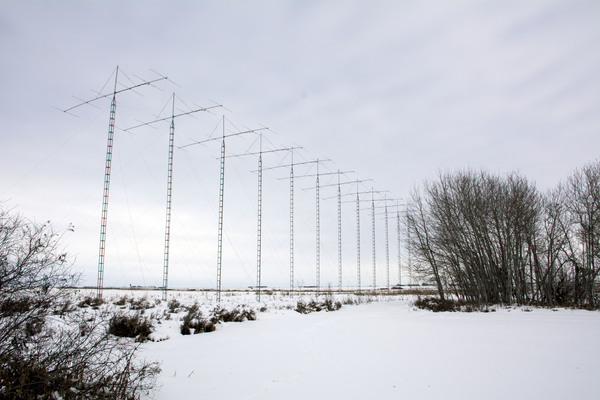
ICEBEAR is developed and run out of the university of Saskatchewan. It consists of two arrays of 10 radars, one array is used as a transmitter, and one array is used as a receiver. ICEBEAR operates at a very high frequency (VHF) of 49.5 MHz.
The transmitting series of antennas are located near the Saskatchewan/Alberta Border and the receiving set of antennas are located just outside of the city of Saskatoon. The bistatic nature of the radar allows the system to use a continuous wave (CW) signal.
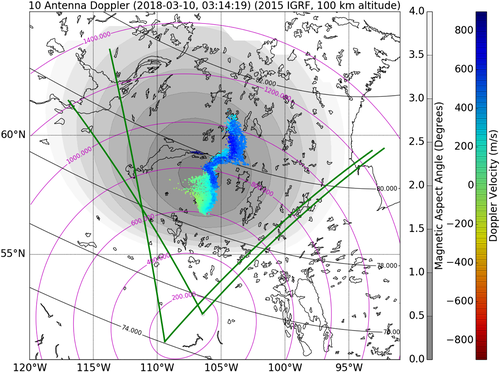
The targets for ICEBEAR are auroral ionospheric E region plasma and meteor trails. To do this ICEBEAR measures range, aximuth, and elevation of returning echoes. The field of view can be seen in the diagram to the right.
Ionosphere
The ionosphere is the partially ionised transition region between the neutral atmosphere below and fully ionised space above. An ionised medium has electrons and ions, electrically charged particles, which are `free' to move around. Electric and magnetic fields, which are present almost anywhere, interact strongly with ionised mediums exhibiting significantly different behaviour than the neutral atmosphere we are familiar with on the Earth's surface. As the ionosphere begins at roughly 100 km altitude only rockets or satellites can directly observe the medium; however, a way to remotely probe this region is by using radars.
ICEBEAR-3D, makes detailed observations of the lowest portion of the ionosphere, the E-region, which is the first ionised layer above the neutral atmosphere. The radar is able to detect the motion of ionised particles. This charged particle motion is equivalent to an electrical current and is also responsible for the beautiful aurora borealis (northern lights) displays.
History
The original ICEBEAR was developed at the University of Saskatchewan, that was first operational on December 2017. The original ICEBEAR transmitter and receiver antenna arrays were both uniform linear arrays and is continuous wave bi-static.
This means that the transmitting and receiving antennas need to be separated. The ICEBEAR transmitter site is located in the southwest portion of the province Saskatchewan, near Prelate, SK, Canada, while the receiver site is located just outside of Saskatoon. ICEBEAR also utilizes Software Defined Radio to transmit and receive, allowing data to be digitized.
However, this design limited ICEBEAR spatially to only locating targets in range and azimuth and introduced azimuthal ambiguity. The motivation to improve ICEBEAR's ambiguity in data and locate targets with range, azimuth and elevation led to the redesign of ICEBEAR to ICEBEAR 3-D
ICEBEAR-3D
Starting in the summer 2019 a new non-uniform receiver antenna array was designed and constructed. This uses the original ICEBEAR infrastructure, but included improvements to the receiver antenna array configuration and post processing in order to achieve 3-dimensional positions of targets.
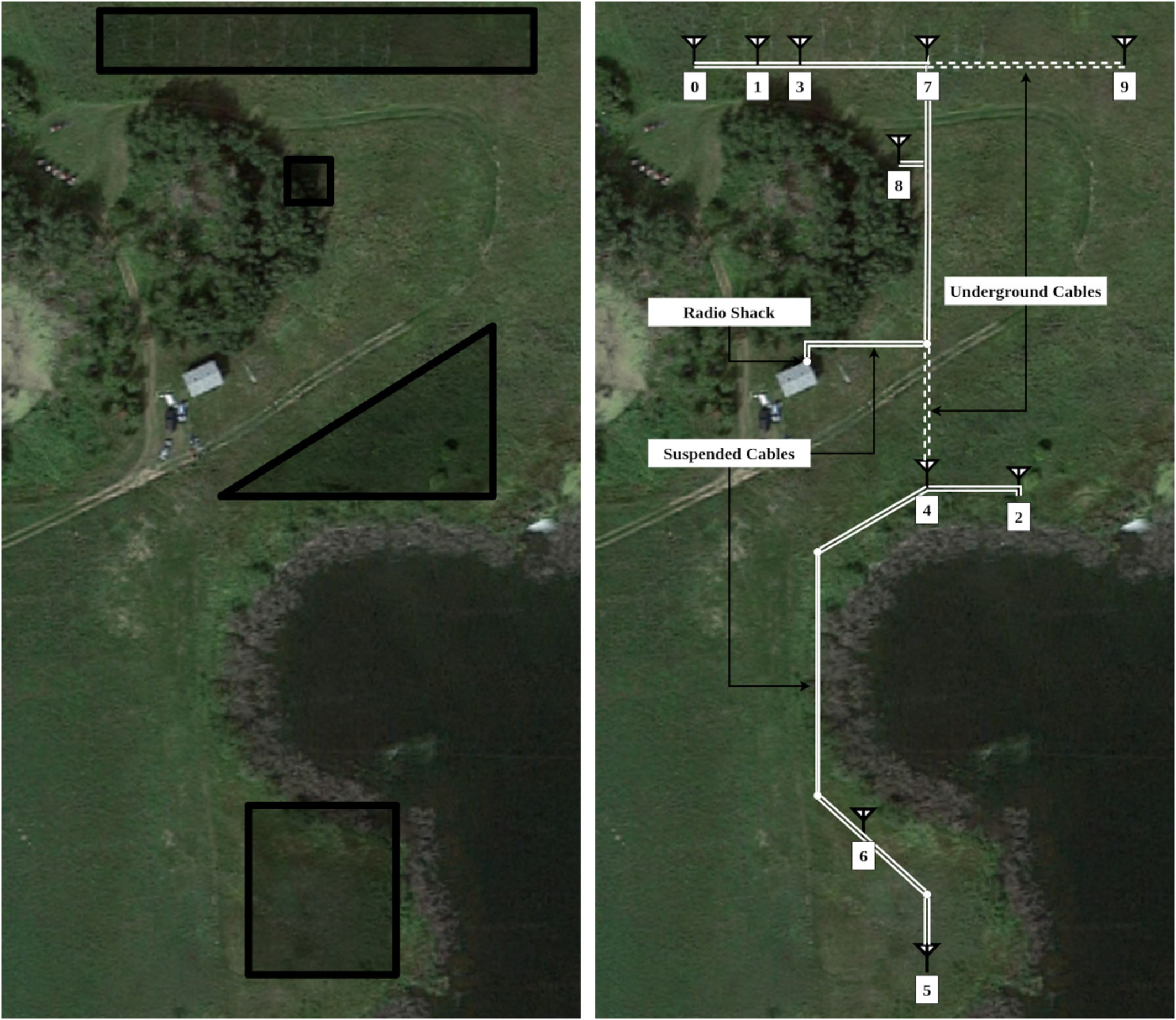
We can obtain range by measuring time of flight of transmitted signal. Azimuth is obtained by comparing phase differences between antennas in the linear array of received echoes. Elevation angles is done similarly to finding the azimuth angles, but requires antennas that are orthogonally positioned to an azimuth measuring array.
Note how the uneven spacing creates 45 unique baselines, minimizing phase error and allowing for a 0.1° angular resolution over a 0° to 45° elevation angle.